- No Mercy Medtech
- Posts
- The $15 chip replacing a $100K lab system
The $15 chip replacing a $100K lab system
It's 2026. Blood analysis has been automated for decades. Why is semen analysis still stuck in the analog era?

Lisa Voronkova
February 17, 2026 • Estimated Reading Time: 9 minutes

When you get a blood test, an automated analyzer processes your sample in minutes. Consistent results, no human error; standard of care since the 1980s.
But when a man gets a semen analysis, a lab technician sits behind a microscope and counts sperm manually. Estimates motility by eye. And the result depends - more than anyone would like to admit - on how experienced that technician is.
This is not a niche corner of medicine.
Male factor infertility accounts for about 50% of all infertility cases. WHO estimates roughly 1 in 6 people globally experience infertility. The IVF market alone is $28 billion in 2025 and growing at 6–9% CAGR.
And yet, the diagnostic step (figuring out what's going on with the sperm) is still done the same way it was 30 years ago.
Blood chemistry lends itself to automation.
You're measuring concentrations: glucose levels, hormone markers, ion counts. Sensors and reagents handle this well. That's why companies like Beckman Coulter and Roche built empires around automated blood analyzers starting in the 1960s.
Semen analysis is a different beast. You're not measuring a concentration. You're doing structural analysis: looking at living organisms under a microscope, tracking how they move, assessing their shape, and counting different categories. It's pattern recognition — exactly the kind of task that resisted automation until AI came along.
The WHO recognized this complexity when they released the 6th edition of their semen analysis manual. They reintroduced the distinction between rapid-progressive and slow-progressive motility. They added DNA fragmentation assessment and expanded standardization requirements. Translation: the test is getting more complex, not simpler. And they expect humans to do it consistently.
Good luck with that.
The global semen analysis market sits around $400–900M in 2025, growing at 8% CAGR. The broader male infertility diagnostics market is $4.85B, heading to $8B by 2035.
Computer-Assisted Sperm Analysis - the existing automated approach - is a $48–143M segment depending on how you count it. These are systems like Hamilton Thorne and Microptic SCA. They work.
They're also expensive, bulky, and still require trained operators.
At-home testing is the fastest-growing slice: 14.2% CAGR. YO Home Sperm Test has FDA clearance for a smartphone-based system. ExSeed has CE marking in Europe. Fellow does mail-in analysis through CLIA labs.
But none of these run real AI on the device itself. YO does video analysis on a phone. CASA systems run proprietary software on dedicated workstations. At-home kits either give you a simple count or ship samples to a lab.
The gap: a device that runs deep learning inference locally, in real time, without sending data anywhere.
That's what we built.
What we built: Edge AI Sperm Analysis
At OVA Solutions, we develop medical devices. We build for clients, but we also have our own R&D.
One project we've been working on: a real-time sperm analysis system that runs entirely on an embedded chip, no cloud, no internet connection
No data leaves the device
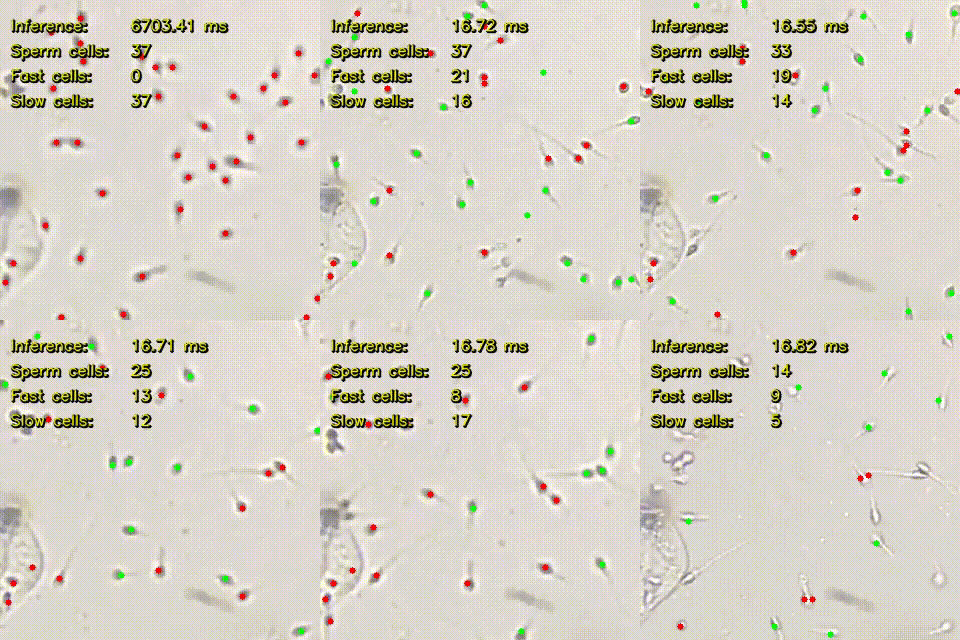
The system captures microscope video and runs a YOLOv8 Nano model, quantized to INT8 and deployed on the NPU of an NXP i.MX 8M Plus chip.
Performance:
Single frame inference: 16.5 ms
Full-resolution frame analysis: ~200 ms
1 second of sperm observation → results in ~5 seconds
Complete analysis cycle: 20–30 seconds
Detects 40+ objects per frame
Classifies: motile vs. non-motile, progressive vs. slow, morphology assessment
Cost of the chip: $15–25.
We also built an automated dataset generation pipeline, no manual labeling. Python + OpenCV auto-generates bounding boxes from high-contrast microscope video. This matters because labeled medical datasets are expensive and slow to create.
The full analysis pipeline runs on a chip that draws about 1 watt.
For comparison: traditional CASA systems cost $20,000–100,000, require a dedicated workstation, and need a trained operator. Our approach puts the analysis brain inside the microscope accessory itself.
The standard approach to AI diagnostics: capture video → upload to cloud server → run analysis → return results.
Sounds reasonable. Here's why it's not great for semen analysis.
1) This is among the most personal medical tests a man can take. Sending that video to a cloud server means you need the full HIPAA/GDPR stack: patient identification, encryption, data retention policies, BAA agreements. Our device doesn't know whose sperm it's analyzing (is a feature, not a bug). The clinic handles patient records in their own compliant system. The analysis device just produces a report.
2) Clinics in Ukraine, rural India, Latin America, or any facility without reliable internet should still get world-class diagnostics. On-device processing means the device works the same whether you're in Manhattan or Mombasa.
3) Cloud infrastructure adds per-test costs. On-device is a one-time hardware investment. 20–30 seconds on device vs. upload time + server queue + download. For a clinic doing 50 tests a day, this adds up.
NXP just partnered with GE HealthCare in January 2026 to bring edge AI into acute care equipment. Nordic Semiconductor announced the nRF54LM20B — a new chip with an Axon NPU designed for ultra-low-power AI applications. The hardware ecosystem is catching up fast.
Where the regulators stand
If you're building an AI-powered semen analyzer, here's the regulatory picture.
FDA classification: semen analysis devices fall under product code POV — Class II, 510(k). Your predicate is any existing automated semen analyzer. Adding AI doesn't automatically change the class - the January 2025 FDA guidance on AI-enabled devices makes this clear.
PCCP is a game changer. The FDA's Predetermined Change Control Plan lets you pre-approve a framework for updating your AI model. Train on more data, improve accuracy, deploy - without filing a new 510(k) each time. PathAI just got the first PCCP in digital pathology. Semen analysis can follow the same playbook.
Home use path: if you want OTC/home use, you'd need a dual 510(k) + CLIA waiver - the device must prove a lay user can get lab-comparable results.
YO Home Sperm Test already paved this road.
Europe: under IVDR, most semen analyzers fall into Class B. Requirements are higher than under the old IVDD, but a simplification proposal is in progress.
The regulatory environment is actually favorable right now for AI diagnostics. The infrastructure is there.
Someone just needs to build the device. 😁
Sperm analysis is our starting point, but the real opportunity is the entire category of structural analysis under a microscope. Every lab where a human looks through a microscope and makes a judgment call.
Ovulation testing - saliva crystallization patterns that predict fertility windows. Today, women squint at a mini-microscope and guess. An AI chip could make it definitive. Bacteriology - colony identification and counting. Histology and cytology. Water quality - microplastics and contaminant detection. Blood smear morphology.
Digital pathology already went through this transition. Paige.AI got the first FDA-cleared AI for histopathology. The digital pathology market hit $1.2B in 2024 and is heading to $2.6B by 2032.
Semen analysis is at the same inflection point where blood chemistry was before the Coulter Counter, and where digital pathology was before Paige.AI. The labs that adopt AI-assisted structural analysis first will set the standard. The rest will spend the next decade catching up.
If you're building a diagnostic device and need engineering support - from concept through FDA - book 30 minutes with me.
If you want the complete playbook for building medical devices from scratch, my book Hardware Bible is on Amazon.
Lisa
Founder & CEO, OVA Solutions
Author, Hardware Bible
No Mercy MedTech is a bi-weekly newsletter for engineers, founders, and investors who build medical devices. Subscribe if someone forwarded this to you.