- No Mercy Medtech
- Posts
- Boston Scientific bets $14.5 Billion on one segment
Boston Scientific bets $14.5 Billion on one segment
and here's why

Lisa Voronkova
February 03, 2026 • Estimated Reading Time: 13 minutes
Boston Scientific Buys Penumbra For $14.5 Billion
In late January, Boston Scientific announced the acquisition of Penumbra for approximately $14.5 billion. This isn't just another deal in a long list of medtech M&A. This is the largest device transaction of the year, and it says a lot.
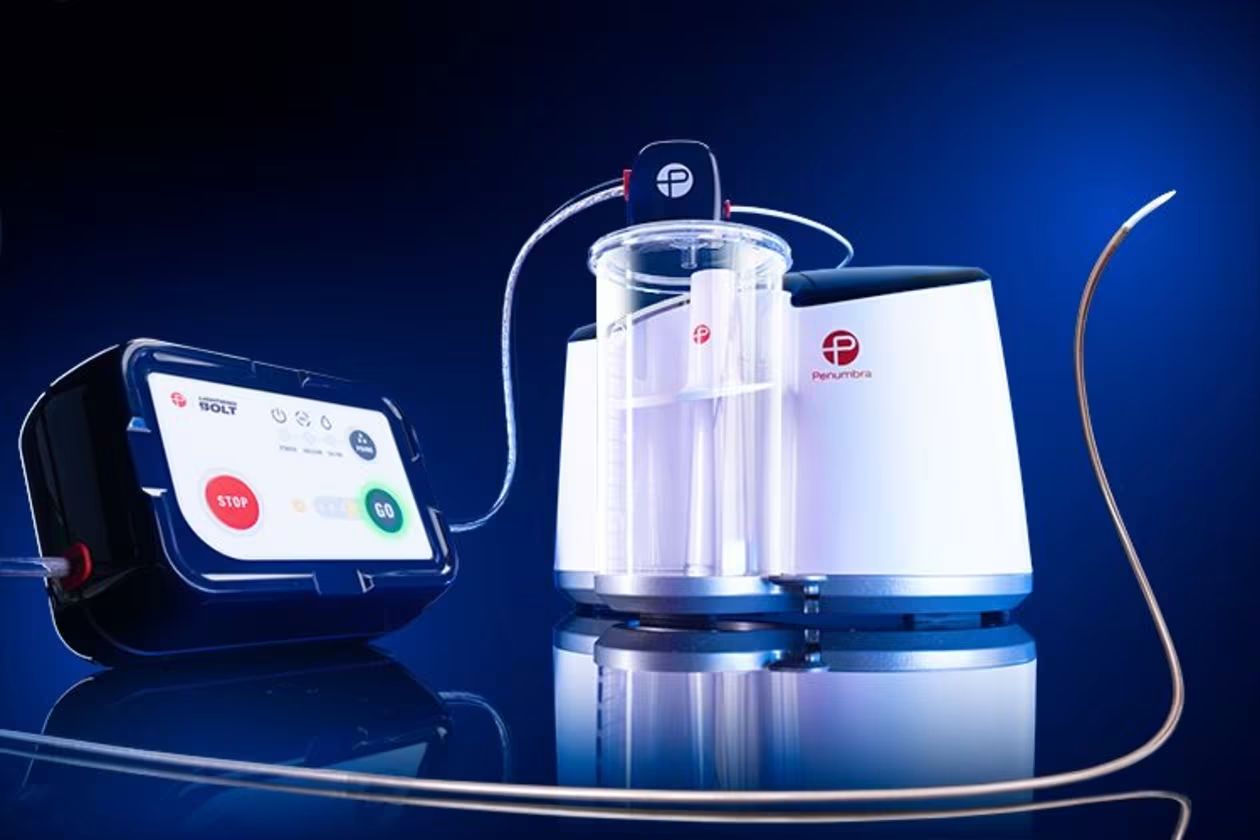
Penumbra makes devices for thrombectomy — mechanically removing blood clots from vessels, most often in the brain during stroke or in other critical arteries. The technology is complex, requires high precision, used in critical situations, and Penumbra has one of the best platforms on the market.
Boston Scientific already publicly stated they're targeting over 10% organic growth annually for 2026-2028. For a company their size, that's an ambitious goal.
Buying Penumbra gives them a dominant position in neurovascular interventions, a segment growing double-digits because hospitals are investing in stroke centers and comprehensive care units. MedTechDive
But BSX didn't stop there.
Same month, they bought Valencia Technologies — a company doing neuromodulation for treating urological incontinence through tibial nerve stimulation. Deal size undisclosed, but the pattern is clear: neuromodulation plus interventional technologies equals strategic priority.
Boston Scientific is building an ecosystem around minimally invasive procedures in two zones: cardiovascular system and neuro.
Both zones require capital investments from hospitals in equipment, staff training, and creating specialized departments. This means high barriers to entry for competitors and predictable long-term contracts for device manufacturers.
What Happened At JP Morgan Healthcare Conference
JP Morgan Healthcare Conference ran January 12-15 in San Francisco.
This is the largest annual healthcare event where public companies, investors, analysts meet, and where major deals are usually announced or year forecasts given.
This year the conference closed $8.3 billion in announced deals, but almost everything went to biopharma - licensing agreements, drug development alliances. Medtech companies didn't announce a single mega-deal on stage.
Analysts wrote directly: "many meetings, zero mega-deals." Fierce Biotech
But if you look at what medtech companies said in their presentations, it becomes clear where the industry is moving:
1) CAPEX cycle in hospitals is starting to recover. After a cautious 2025 when many hospital networks postponed purchases of expensive equipment due to financial pressure, JPM26 analysts talked about 2026-2027 being a period of recovered investment in capital equipment — robotic surgery, imaging systems, interventional platforms. DelveInsight
2) Neuromodulation and implantable systems showing strong growth. Inspire Medical Systems, which makes implantable devices for treating obstructive sleep apnea, gave very aggressive growth guidance at the conference, leveraging expanding indications and geographic expansion. This signals that the implantable neuromodulation device segment has strong momentum. Medical Device Network
3) Structural heart continues to be a priority. Devices for minimally invasive heart operations — valve replacements, defect closures, left atrial appendage occlusion (LAAO) for stroke prevention — all these are areas of sustained investor and hospital interest.
4) AI stopped being a "feature". Companies at JPM talked about AI not as an additional option, but as a mandatory element for diagnostics, workflow optimization, and even revenue cycle management in hospitals. For medtech companies this means if your device doesn't have an AI component for data analysis or usage optimization, you'll lose to competitors. AlphaSophia
Now look at what happened right after the conference.
Several major deals were announced in January, and each directly hits JPM26 themes:
W. L. Gore bought Conformal Medical — a company developing a system for LAAO (left atrial appendage occlusion). Direct hit on the structural heart interventions trend. Life Science Market Research
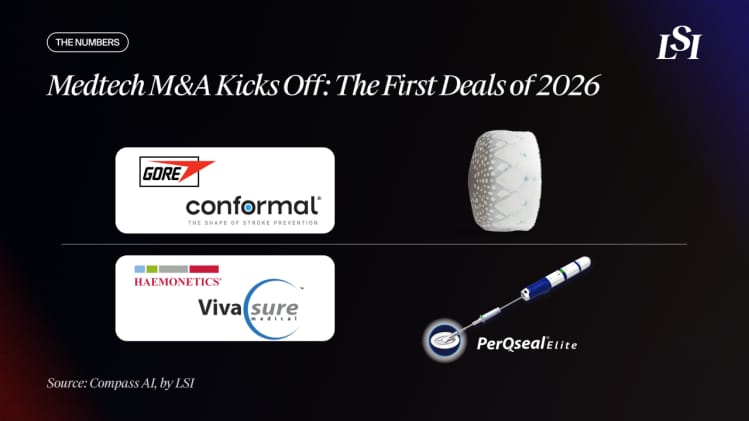
Haemonetics bought Vivasure Medical, which makes devices for closing large vascular access sites after procedures like TAVI or EVAR. A logical addition to the interventional ecosystem discussed at JPM; not just doing the procedure, but managing all stages of patient journey, including access closure. Life Science Market Research
Smith & Nephew bought Integrity Orthopaedics for up to $450 million. Integrity makes devices for rotator cuff repair — an orthopedic niche, but it shows how major orthopedic companies are strengthening portfolios with targeted acquisitions in growing segments. MedTechDive
Resonetics bought Resolution Medical — a contract manufacturer of complex Class II and III devices for neuromodulation, structural heart, and interventional cardiology. Signal that major OEMs understand: complex, high-precision devices need to be made by specialized contract partners who can scale with growing demand. Lawrence Evans
What does this mean if you're building a medical device?
JPM26 didn't announce mega-deals "from stage," but gave a clear map: structural heart, neuromodulation, hospital capital investment recovery, AI as mandatory infrastructure. January M&A materializes exactly these directions.
Deals happen "behind the scenes," but they follow direct logic of what was discussed at the conference.
Q4 2025 Earnings
In late January, major medtech companies started publishing fourth quarter 2025 results.
Stryker published their report January 28. Their Q4 revenue was $7.17 billion, up 11.4% year over year. Organic growth (excluding currency and acquisitions) was around 10%. Strong demand shown by MedSurg & Neurotechnology and Orthopaedics & Spine segments. Company gave 2026 guidance continuing growth at same pace. StockTitan
AngioDynamics showed Q4 revenue of $80.2 million, growth of 12.7% year over year. Their MedTech business grew 22% to $35.8 million. Despite decent numbers, stock traded slightly down because analysts see a gap between short-term results and long-term company valuation. AIinvest
Medtronic reported Q2 fiscal 2026 back in November 2025, but numbers are relevant for understanding the overall picture. MedTech segment revenue grows 13% year over year and already represents 45% of company's total revenue (was 43% a year ago). They raised EPS guidance for fiscal 2026 and target 5.5% organic growth. Particularly strong showing from pulsed field ablation for atrial fibrillation treatment and renal denervation for hypertension. News Medtronic
Abbott reported January 22. Q4 results were slightly below revenue expectations, but company gave 2026 guidance with organic growth around 7% and EPS growth around 10%. The Motley Fool
Boston Scientific in their last Q3 2025 earnings call said they're targeting average organic growth of 10% and higher for 2026-2028 period, plus approximately 50 basis points of annual margin expansion and double-digit EPS growth. Investing.com
To summarize: major device companies enter 2026 expecting revenue growth from mid-single-digit (5-7%) to low-teens (10-13%) depending on their product mix.
Market rewards companies showing 10%+ organic growth, especially if that growth comes from high-growth franchises like PFA, neuromodulation, CGM, robotic surgery.
By the way, about Hardware Bible
If you're interested in how these M&A deals are structured, how buyers evaluate targets, which regulatory pathways are critical for making your company acquisition-ready, and how hospitals actually make device purchasing decisions - I collected all this in Hardware Bible.
From clinical validation to post-market surveillance, all stages covered with practical examples.

Funding
January overall showed several rounds, but exact dates not publicly specified:
Spiro Medical raised Series A of $67 million (healthcare hardware/manufacturing)
Inquis Medical raised Series C of $75 million (healthcare hardware)
MedWatch Technologies raised Series A of $15 million (wearables and hardware)
Median round size around $10 million.
Yet healthcare funds publicly announced $4.5 billion in capital to deploy - GHO Capital with $2.9 billion, Sofinnova Partners with $750 million, Medicxi with $540 million, Olympus Innovation Ventures with $150 million, T1D Fund targeting $150 million.
Money exists.
But actual deals are quiet. VCs are either waiting for more clarity on regulatory landscape after the recall wave we wrote about in January, or the bar for proving traction has seriously risen.
Investors want to see real clinical outcomes, contracts with hospitals, proof that the device isn't just approved but actually being used and improving care.
Super Bowl 2026: health goes into national advertising
February 8 is Super Bowl LX. This year "health" became a separate category in advertising narrative. This matters because Super Bowl is the largest advertising platform in the US, where 30 seconds of airtime costs millions of dollars, and companies choose for this slot only what they consider a mass trend.
Who's airing with health messaging:
Hims & Hers — a telemedicine platform and diagnostic test provider — is doing a spot called "Rich People Live Longer" about the health-wealth gap. Their message: there are two healthcare systems in the US — one for the rich (space billionaires, biohackers, concierge medicine), another for everyone else. Hims & Hers promotes remote consultations, at-home health assessments, early cancer screenings, and microdose GLP-1 regimens for weight control as a way to "democratize" proactive health. Fortune
Ro - another direct-to-patient health platform - debuts at Super Bowl with a "Healthier on Ro" campaign featuring Serena Williams as GLP-1 therapy ambassador. They're wrapping weight management and metabolic programs in DTC health brand format. Marketing Dive
Novartis - major pharmaceutical company - continues NFL partnership and makes an emotional spot with former NFL players (Rob Gronkowski, Tony Gonzalez, Bruce Arians) about prostate cancer screening. They use humor around the term "tight ends" (an American football position) to normalize the topic of check-ups and show that "getting tested became easier and less scary." Novartis officially became NFL's first pharmaceutical partner and declares goal to "educate and mobilize fans for early cancer and disease detection."
Boehringer Ingelheim makes a "Mission: Detect the SOS" spot where Octavia Spencer and Sofía Vergara show an action scenario (motorcycles, urgent situations, SOS signals) and it all comes down to one simple action: take a uACR urine test for early kidney damage detection.
Adweek calls this "Wellness Bowl" - a noticeable shift toward health and wellness messaging in advertising around the game. Adweek
Super Bowl airtime cements the normalization of DTC diagnostics and telemedicine at national scale. Pharmaceutical companies and health-tech platforms are essentially "selling" screening behavior as a mass habit, using NFL audience and celebrities.
For traditional medical device companies this is a signal: mass attention and big marketing budgets are flowing to screening, remote care, metabolic health.
Any hardware or SaMD that can embed in these trajectories (at-home tests, connected devices, continuous monitoring) gets strong marketing tailwind. Consumers are already ready for the idea that they can do medical tests at home, get results online, and manage their health proactively. This opens new distribution channels and new business models for device companies.
Leadership: STAAR Surgical in transition mode
February 2, STAAR Surgical announced they're appointing Warren Foust and Deborah Andrews as interim co-CEOs while they search for a permanent CEO. This decision came amid pressure from activist investors and questions about the company's growth strategy.
This is part of a broader wave of CEO turnover in medtech that's been going since 2023. Invacare, Globus Medical, NeoGenomics, Insulet, Dexcom - all these companies changed top leadership in the last two years. MDDIonline
For the device industry this is a reminder: even if a company is public and has products on market, if investors don't see a clear growth trajectory or execution problems, they'll push for leadership change. This is especially relevant for companies in the middle zone; not small startups, but not giants like Medtronic or J&J either.
Patients are waiting for better solutions. Money exists. Deals are happening. But requirements for execution quality, clinical proof, and strategic fit are higher than they were two years ago.
If you're building hardware and want my team to handle engineering while you focus on business - 👇👇👇👇👇
Lisa